
Before You Submit: A 12-Step Plagiarism Check Beyond the Percentage
Check a paper for matching text, review quotations and citations, fix risky paraphrases, and interpret similarity results fairly before submission.
Finishing a paper can create a false sense that the difficult work is over. The argument is complete, the conclusion is written, and the reference list appears to be in place. However, the final hours before submission are often when citation mistakes, overly close paraphrases, forgotten quotation marks, and copied notes become visible.
A plagiarism checker can help identify these risks, but the percentage at the top of a report does not tell the complete story. A paper may receive a noticeable similarity score because it contains properly quoted material, a standard assignment title, technical terminology, or an extensive bibliography. Another paper may receive a low score while still presenting someone else's ideas without adequate credit.
The purpose of a plagiarism check is therefore not to chase a perfect zero. It is to locate matching language, understand why each match exists, and decide whether the text requires a quotation, citation, rewrite, or no change at all. This process combines automated matching with careful source review and editorial judgment.
The following twelve-step workflow is designed for students, researchers, writers, editors, marketers, and professionals preparing a document for submission or publication. It begins with preserving the original draft and ends with a final integrity check that protects both the writer and the reader.
- Define what the plagiarism review must accomplish
- Preserve the original draft and research trail
- Prepare the correct text for checking
- Run the plagiarism scan carefully
- Interpret the similarity percentage in context
- Review every important match individually
- Check quotations and common language
- Repair paraphrases without patchwriting
- Verify citations and the bibliography
- Identify reused and self-plagiarized material
- Handle academic and professional reviews fairly
- Complete the final originality check
1. Define What the Plagiarism Review Must Accomplish
Begin by identifying why the document is being checked. A university paper, website article, journal submission, client report, résumé, and marketing campaign may all require originality, but they do not necessarily follow the same citation rules.
An academic paper normally needs formal attribution for quotations, paraphrased ideas, data, and specialized claims. A commercial article may use hyperlinks instead of parenthetical citations. A technical document may legitimately repeat product names, legal phrases, or standard instructions. A résumé usually does not contain a bibliography, but copying another person's achievements or project descriptions would still be misleading.
Review the rules supplied by the institution, publisher, employer, or client. Confirm the required citation style, permitted similarity threshold if one has been formally defined, rules about reusing previous work, and whether AI-assisted editing must be disclosed.
Important distinction: A similarity report identifies matching text. It does not automatically determine whether plagiarism occurred. The final interpretation depends on the source, context, attribution, and applicable rules.
Writing down the purpose before scanning prevents an unhelpful goal such as “make the score zero.” The correct objective is to make every borrowed idea and phrase transparent, accurately represented, and properly credited.
2. Preserve the Original Draft and Research Trail
Save a copy of the document before making corrections. The original version allows you to compare changes, understand how an error occurred, and demonstrate the development of the work if a question arises later.
Keep relevant research notes, outlines, source PDFs, saved web addresses, interview records, and earlier drafts. These materials can show where an idea originated and whether text was deliberately copied, temporarily placed as a note, or accidentally left without attribution.
Many plagiarism problems begin during research. A writer copies a useful paragraph into a notes document but forgets to include quotation marks or the source URL. Days later, the passage looks like original notes and is transferred into the final paper. Separating direct quotations, paraphrases, personal observations, and source details at the note-taking stage reduces this risk.
- Place exact copied language inside quotation marks immediately.
- Record the author, title, URL, publication, and access date where required.
- Label personal observations separately from source notes.
- Use clear file names for successive drafts.
- Do not delete earlier versions merely because the final document is complete.
A reliable research trail is not only a defense against accusations. It also makes the final revision faster because the information needed to repair a citation is already available.
3. Prepare the Correct Text for Checking
Decide whether the full document or selected sections should be analyzed. A complete paper provides context, but reference lists, templates, assignment instructions, and legally required language can raise the similarity percentage without revealing a genuine originality problem.
Do not remove suspicious passages before the first scan. The initial check should represent the document you were preparing to submit. After reviewing the results, you can make corrections and perform a second scan.
Long documents may need to be divided into sections when a tool has an input limit. The Word Counter can help measure each section and create consistent portions. Split at logical boundaries such as headings or complete paragraphs rather than cutting a sentence in half.
Check that text copied from a PDF or website remains readable. Broken words, repeated headers, missing punctuation, and mixed columns can produce misleading matches. Preserve headings and paragraph boundaries when they help explain where a passage belongs.
| Document Element | Include Initially? | Reason |
|---|---|---|
| Original body paragraphs | Yes | These contain the primary writing being evaluated |
| Direct quotations | Yes | The report can confirm whether attribution needs review |
| Bibliography | Usually yes | Keep the complete submission intact for the first scan |
| Assignment instructions | Usually no | They were supplied to every participant and are not the writer's work |
| Required template text | Record separately | It may explain repeated language across submissions |
4. Run the Plagiarism Scan Carefully
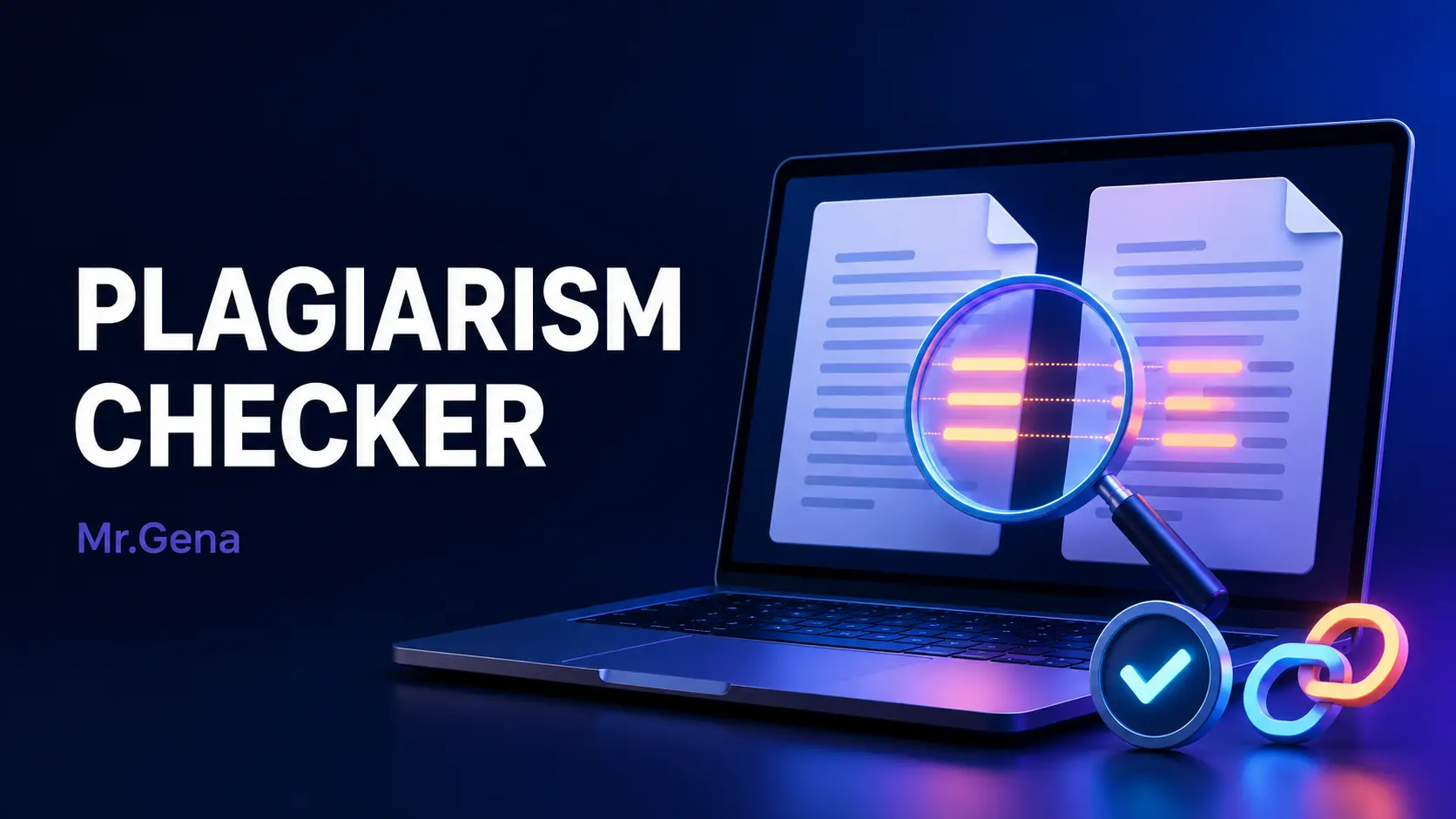
Paste the prepared text into the Mr.Gena Plagiarism Checker and begin the scan. The tool compares the submitted language with discoverable online material and highlights matching phrases that require review.
Save the result or record the important matches before editing. Note the date, document version, section checked, overall result, and sources identified. If a report is generated from several separate sections, keep the results labeled so that a match from the introduction is not confused with one from the literature review.
A scan should not be treated as a private confession or automatic misconduct report. It is an editorial diagnostic. Some highlights will reveal genuine problems, while others will be correctly quoted material, common expressions, titles, names, or unavoidable technical terminology.
A tool also cannot identify every possible source. Material may come from a printed book, private document, subscription database, translated source, unpublished paper, video, podcast, or page that is not available to the checker's search index. A clean result therefore means that no significant discoverable match was found within the system's reach—not that originality has been proven absolutely.
5. Interpret the Similarity Percentage in Context
The overall percentage shows how much text matched sources according to the platform's method. It does not reveal whether each match is acceptable. A 20% result composed of properly quoted research may be less concerning than a 5% result containing one uncited paragraph copied from another writer.
Turnitin's official explanation of understanding the similarity score states that quoted and referenced text can still appear as a match. It describes the score as a percentage of matching text and recommends using the report as part of a review rather than treating it as an automatic misconduct decision.
Do not transfer Turnitin's colors or percentage ranges directly to every plagiarism checker. Platforms may use different databases, matching rules, filters, and calculation methods. Always interpret the result according to the tool that produced it and the policy that applies to the document.
Similarity scores should also remain separate from AI-detection results. Our previous guide on how to read AI detector scores explains why machine-writing probability and text similarity answer different questions. A passage can match a source regardless of whether it was typed by a human or generated using AI.
Better question: Instead of asking, “Is this percentage too high?” ask, “Which matches are meaningful, why do they exist, and has each source been handled correctly?”
6. Review Every Important Match Individually
Open the source connected to each substantial match. Compare the wording, context, publication date, author, and surrounding argument. Do not assume the first source displayed is necessarily the original source. Several websites may have republished the same material.
Classify each match before making changes:
- Correct quotation: The wording is exact, quotation marks are present, and the source is properly cited.
- Missing quotation marks: The source is cited, but copied language is presented as a paraphrase.
- Missing citation: The wording or idea came from a source that is not credited.
- Close paraphrase: A few words changed, but the sentence structure remains too similar.
- Common language: The match contains a standard expression, title, technical term, or unavoidable phrase.
- False or irrelevant match: The similarity is too short or generic to be meaningful.
Start with the longest and most distinctive matches. A complete uncited sentence deserves more attention than a two-word expression used across thousands of pages. However, several small matches from the same source may reveal patchwriting when viewed together.
Keep a short decision note for disputed matches. This is especially useful when several people are editing a report or when a teacher, editor, or client may later ask why a highlighted passage was retained.
7. Check Quotations, Attributions, and Common Knowledge
Exact language from a source normally requires quotation marks or block-quotation formatting in addition to a citation. A citation alone tells the reader where the information came from; it does not show which words were copied exactly.
The Harvard Guide to Using Sources explains that inadequate citation can constitute plagiarism whether the failure is intentional or accidental. This is why good intentions do not remove the need for careful attribution.
Check that every quotation is accurate. Do not change a word inside quotation marks without indicating the modification according to the required style. Confirm page numbers, speaker names, dates, and links. A quotation should also represent the source fairly rather than removing a sentence from context to suggest the opposite conclusion.
Common knowledge usually does not require citation, but the boundary depends on the audience and subject. Widely known dates may be common knowledge, while a specialized research finding, distinctive interpretation, or precise statistic still requires a source. When uncertain, citing a reliable source is normally safer than presenting a specialized claim as universally known.
8. Repair Paraphrases Without Patchwriting
Paraphrasing means expressing a source's idea accurately in genuinely new language and structure. It does not mean replacing several words with synonyms while preserving the original sentence pattern. That method is often called patchwriting and may remain too close to the source even when a plagiarism checker produces a lower match.
Read the source until you understand the idea, then close or hide it. Explain the point from memory in language suitable for your argument and audience. Reopen the source, compare meaning, correct any distortion, and add the required citation.
The Paraphrasing Tool can provide alternative ways to express a difficult sentence, but its output should not be used to disguise copied material. Verify that the new version preserves the source's meaning, does not introduce unsupported claims, and fits naturally with the rest of the paper.
Our earlier article on humanizing AI-assisted text discusses meaning preservation, specific language, sentence rhythm, and human review in greater detail. Those principles also apply to ethical paraphrasing: the final sentence must communicate an understood idea, not simply look different from the source.
| Method | Main Problem | Better Practice |
|---|---|---|
| Replace words with synonyms | Original structure and logic remain copied | Explain the idea after understanding it |
| Remove the citation after rewriting | The underlying idea still belongs to the source | Keep attribution for borrowed ideas |
| Combine several uncited sources | Creates a paragraph with unclear ownership | Track and cite each relevant contribution |
| Use automated rewriting without review | Meaning, evidence, and terminology may change | Compare the result with the original source |
9. Verify Citations and the Bibliography
Every in-text citation should lead to a complete entry in the reference list, and every listed reference should normally be used in the document. Check author names, publication titles, dates, page numbers, DOI values, and URLs against the original source.
Microsoft's official guide to creating citations, references, and bibliographies in Word explains how sources can be added, reused, and formatted through the References tools. Automated formatting saves time, but the source information entered by the writer must still be accurate.
For a long reference list, the Alphabetize Tool can help sort entries consistently when the required citation style uses alphabetical order. Review names containing prefixes, organizations, works without named authors, and multiple publications by the same author because citation styles may apply special ordering rules.
- Every direct quotation has a citation.
- Every paraphrased idea has appropriate attribution.
- Each in-text citation has a matching reference entry.
- Links and DOI values open the intended sources.
- The reference style is applied consistently.
- No source is listed merely to make the research appear broader.
10. Identify Reused and Self-Plagiarized Material
Writers sometimes assume they can reuse any previous text because they originally wrote it. However, submitting the same work in a new academic, publishing, or client context may violate expectations even when no other author is involved.
Examples include submitting one assignment to two courses, copying sections from an earlier article without disclosure, reusing a client's paid deliverable for another customer, or presenting an old report as newly researched work.
Policies differ. Some publishers permit limited reuse of methods or standard descriptions with citation and disclosure. Some institutions require written permission before reusing previous coursework. Clients may own the delivered content under the contract. Check the applicable rules rather than assuming that original authorship creates unlimited reuse rights.
If reuse is allowed, tell the reader where the material appeared previously and cite it when appropriate. Update outdated facts, figures, links, and conclusions. Reusing an old paragraph without confirming that it remains accurate creates both originality and quality problems.
11. Handle Academic and Professional Reviews Fairly
Teachers, editors, and clients should avoid applying a universal “acceptable percentage” without examining the document. A literature review may naturally contain more quotations and citations than a personal reflection. A legal document may repeat required language. A technical specification may contain unavoidable product terminology.
When a concerning match appears, identify the passage and source clearly. Give the writer an opportunity to explain, provide notes, correct an accidental citation error, or respond according to the relevant policy. A high-stakes decision should not be based only on the color of a report icon.
Professional documents also require context. Résumés often use common phrases such as “responsible for,” “managed projects,” or “worked with cross-functional teams.” These expressions may match many online examples without proving that an applicant copied another person's experience. The real concern is whether the achievements, employers, skills, and results are truthful.
Writers creating a new application document can use the Resume Builder to organize their own contact information, experience, skills, and education instead of copying the structure and claims of another person's résumé.
Fair-review principle: Similarity should open an investigation, not close it. Examine the actual source, attribution, document type, policy, and writer's explanation before deciding what the match means.
12. Complete the Final Originality Check
After correcting quotations, paraphrases, citations, and reused material, perform a second scan. Compare the new report with the original instead of focusing only on whether the percentage decreased.
Confirm that meaningful matches were resolved for the correct reason. A copied paragraph should not disappear merely because synonyms were inserted. It should become an accurate quotation, a genuinely original paraphrase with citation, or a removed passage when it does not belong.
Run a separate language review using the Grammar Checker. Correcting grammar is not the same as checking originality, but errors introduced during paraphrasing can distort a source's meaning or make the revised paper difficult to understand.
Finish with a manual review:
- Read the title, assignment instructions, and submission requirements again.
- Check every highlighted match that remains in the final report.
- Verify quotations against the original sources.
- Confirm that paraphrases represent the source accurately.
- Match every in-text citation with the reference list.
- Open all links and DOI records.
- Review spelling, grammar, formatting, and page order.
- Save the final document and relevant research trail.
A paper is ready when its sources are transparent, its argument is genuinely understood, and every retained match has a defensible explanation. The final percentage is supporting information—not the definition of integrity.
Frequently Asked Questions
What is an acceptable plagiarism percentage?
There is no universal percentage suitable for every document or institution. The meaning depends on what matched, whether the material is quoted and cited, the document type, and the applicable rules. Review individual matches instead of relying only on the total.
Does a 0% similarity score prove that a paper is original?
No. A checker may not have access to every book, private document, translated source, subscription database, or unpublished work. A low score also cannot prove that all ideas were properly attributed.
Why are properly cited quotations highlighted?
Similarity systems identify matching language. Quotation marks and citations may make the use acceptable, but they do not stop the wording from matching the original source.
Can I remove plagiarism by changing a few words?
Changing isolated words while retaining the source's structure may still constitute overly close paraphrasing. Understand the idea, explain it independently, verify the meaning, and cite the source.
Is self-plagiarism possible?
Yes. Reusing earlier work without disclosure may violate academic, publishing, employment, or client expectations. Check the relevant policy and cite or disclose previous work when required.
Should I delete every highlighted sentence?
No. Correct quotations, titles, references, technical terms, and common phrases may be legitimate. Investigate each important match and make a change only when attribution, originality, accuracy, or relevance requires it.
Final Thoughts
A plagiarism checker is valuable because it makes hidden similarities visible before a document reaches a teacher, editor, publisher, employer, or client. Its greatest benefit is not the percentage it produces but the questions it helps the writer ask.
Where did this sentence come from? Is the wording copied exactly? Does the reader know whose idea is being used? Does the paraphrase reflect genuine understanding? Can every citation lead back to a reliable source?
Answering those questions requires more than automated scanning. Preserve your research trail, examine every meaningful match, repair citations carefully, paraphrase from understanding, and review the final document as a complete argument. When technology and human judgment work together, the result is not simply a lower similarity score. It is more transparent, credible, and responsible writing.