

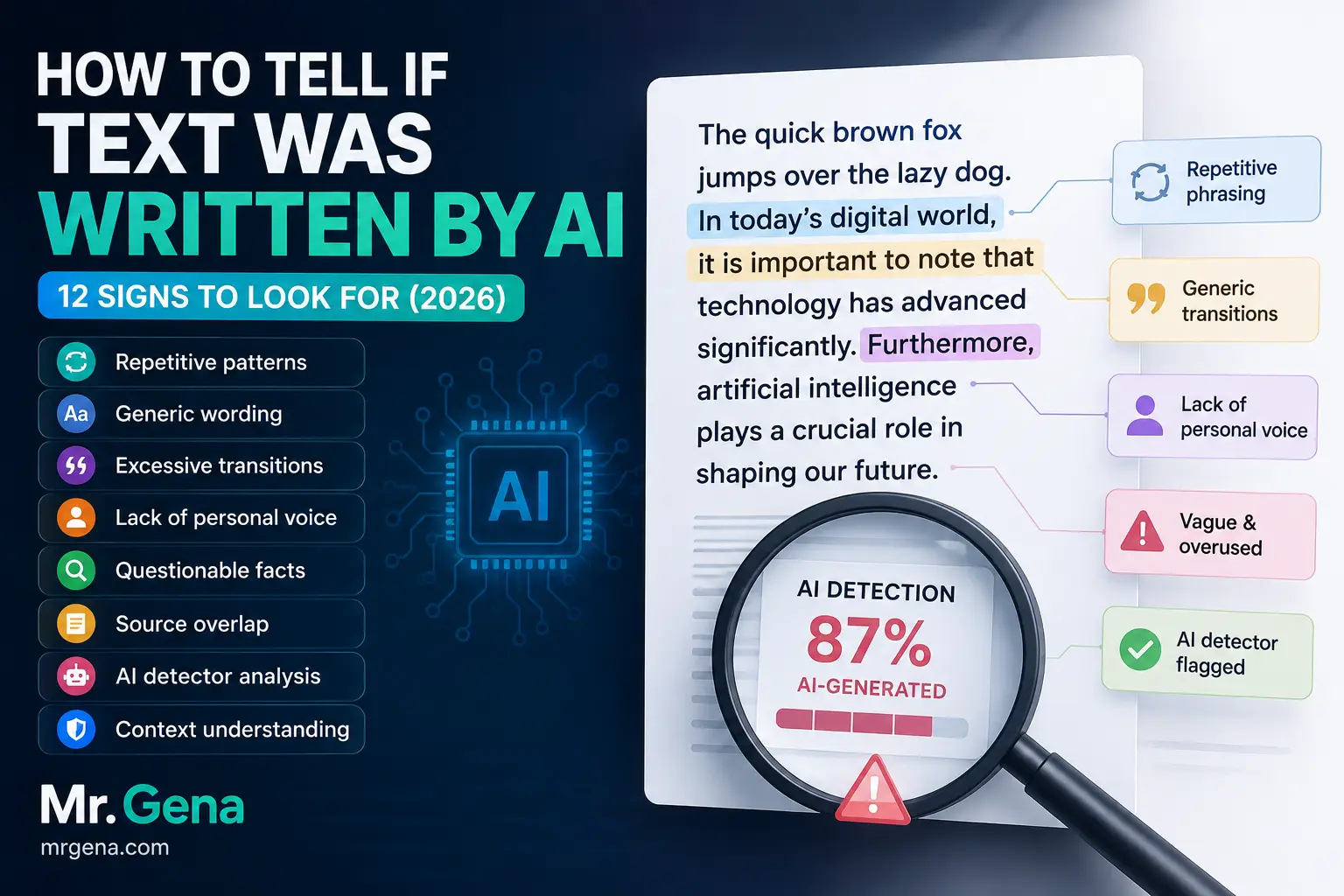
How to Tell If Text Was Written by AI: 12 Signs (2026)
Learn how to tell if text was written by AI using 12 practical signs, writing patterns, verification methods, and AI detection techniques.
AI-generated writing has become significantly harder to recognize. Modern language models can produce polished articles, emails, essays, product descriptions, social posts, and reports that often look perfectly natural at first glance. That means identifying AI-written content is no longer as simple as looking for awkward wording or obvious grammatical mistakes. A more reliable approach is to examine several signals together, including sentence structure, specificity, source quality, repetition, tone, and the way ideas develop across the text.
There is also no single phrase, punctuation habit, or writing style that proves a piece of content was generated by artificial intelligence. Human writers can sound repetitive, highly structured, or overly formal, while AI-generated content can be heavily edited by a person. The goal, therefore, should not be to find one supposed “AI giveaway,” but to build a broader picture from multiple clues. The following guide explains twelve practical ways to evaluate suspicious text more carefully.
- Look for patterns instead of one giveaway
- Examine repetitive sentence structures
- Watch for generic transitions and filler
- Check whether the writing lacks personal texture
- Verify suspicious facts, examples, and sources
- Notice unusually uniform vocabulary and tone
- Test whether the text truly understands its context
- Look for mechanically rewritten language
- Review grammar and punctuation patterns
- Check whether wording overlaps with existing sources
- Use an AI detector as supporting evidence
- Combine multiple signals before reaching a conclusion
1. Look for Patterns Instead of One Giveaway
The first mistake people make when trying to identify AI writing is searching for one magical sign. You may see claims that certain words, punctuation marks, sentence openings, or phrases automatically reveal AI-generated content, but those shortcuts are unreliable. Expressions such as “in today’s digital world,” “it is important to note,” or “ultimately” may appear frequently in machine-generated text, yet human writers use them too. The same is true for em dashes, numbered lists, perfectly structured paragraphs, and polished introductions.
Instead, treat AI identification as a pattern-recognition problem. One generic sentence means very little, but a 1,500-word article containing repeated transitions, identical paragraph rhythms, vague examples, perfectly balanced sentence lengths, and little original insight becomes more suspicious. The strongest evaluations therefore combine structural, linguistic, factual, and contextual signals rather than relying on a single clue.
Important: No individual writing characteristic proves that a text was produced by AI. A reliable assessment should consider several independent signals and the context in which the content was created.
2. Examine Repetitive Sentence Structures
AI-generated content often sounds smooth because language models are extremely good at producing grammatically complete sentences. However, that fluency can sometimes become unusually consistent. Several paragraphs may begin with similar constructions, contain roughly the same number of sentences, and follow an almost identical rhythm: statement, explanation, example, conclusion. When this pattern continues throughout a long article, the writing may feel technically correct but strangely predictable.
Human writing is usually more irregular. A person may follow a long analytical sentence with a short observation, insert an aside, change pace, or emphasize an idea unexpectedly. AI can imitate this variation, especially when prompted to do so, but unedited machine-generated writing often gravitates toward safe and balanced structures. Looking at several paragraphs together is therefore more useful than examining one sentence in isolation.
| Writing Feature | Potential AI Pattern | Common Human Pattern |
|---|---|---|
| Sentence length | Frequently similar across paragraphs | More natural variation between short and long sentences |
| Paragraph structure | Repeated explanation patterns | Structure changes according to the idea |
| Transitions | Frequent and highly explicit | Sometimes implied rather than stated |
| Emphasis | Evenly distributed | Often uneven or personal |
3. Watch for Generic Transitions and Filler
Another useful clue is excessive connective language. AI writing frequently attempts to make every paragraph flow perfectly into the next, which can lead to repeated phrases such as “in addition,” “furthermore,” “on the other hand,” “it is worth noting,” and “in conclusion.” None of these expressions is problematic by itself. The warning sign appears when almost every paragraph announces exactly what it is doing instead of allowing the ideas to connect naturally.
Filler also appears when a text repeatedly restates an obvious point without adding meaningful information. For example, an article about password security might spend several sentences explaining that strong passwords are important before providing any practical guidance. Human writers certainly use filler, but AI systems can produce it at scale because they are optimized to continue a coherent response even when the underlying idea has already been exhausted.
- Check whether the same transition words appear repeatedly.
- Look for sentences that merely restate the previous sentence.
- Notice whether introductions take too long to reach the main point.
- Ask whether each paragraph contributes genuinely new information.
4. Check Whether the Writing Lacks Personal Texture
Human writing often contains small traces of experience that are difficult to produce convincingly without context. These may include specific observations, unusual comparisons, firsthand mistakes, niche terminology, local references, or opinions that develop naturally from the writer’s experience. AI-generated writing frequently remains at a safer level, offering information that sounds reasonable but could apply to almost anyone.
This does not mean first-person writing automatically indicates a human author. AI can easily generate sentences such as “In my experience” or invent a personal anecdote when requested. The better question is whether the details feel connected, specific, and consistent throughout the text. A genuine experience usually contains contextual details that affect later conclusions, whereas fabricated examples may appear briefly and then have no meaningful influence on the rest of the article.
Practical test: Remove the brand name, person, or topic from a paragraph and ask whether the same paragraph could be reused almost unchanged in dozens of unrelated articles. Highly interchangeable writing is often a sign of generic content generation.
5. Verify Suspicious Facts, Examples, and Sources
One of the most important checks has nothing to do with writing style. AI systems can sometimes produce inaccurate statistics, nonexistent studies, incorrect dates, or references that look legitimate but cannot actually be found. This phenomenon is especially dangerous because fabricated information may be presented confidently and formatted just like a real source. A polished writing style should therefore never be treated as proof that the underlying information is accurate.
When a text includes an unusually precise percentage, study title, quotation, organization, legal rule, or historical fact, verify it independently. Search for the original source rather than relying on another page that repeats the same claim. If several citations turn out to be impossible to locate, that is a much stronger warning signal than the presence of a few generic phrases.
AI-written text can also combine correct facts in misleading ways. A date may be accurate, for example, while the conclusion attached to it is not. Verification should therefore cover both the existence of the source and whether the source actually supports the statement being made.
6. Notice Unusually Uniform Vocabulary and Tone
Long-form human writing tends to fluctuate slightly. A writer may become more technical while explaining a complicated concept, more direct when giving instructions, and more conversational when providing an example. AI-generated material can instead maintain a remarkably stable voice across every section, even when the subject changes. That consistency can make an article easy to read while simultaneously making it feel less spontaneous.
Another pattern is over-polished vocabulary. A draft may contain many professional-sounding phrases but very few memorable expressions or distinctive choices. If you are working with AI-assisted content rather than investigating someone else’s work, a tool such as the AI Humanizer can help demonstrate how changing sentence rhythm, phrasing, and structure affects how natural a passage sounds. Comparing the original and revised versions can also make repetitive patterns easier to recognize.
Do not mistake good writing for AI writing, however. Professional editors intentionally create consistent tone. The signal becomes more useful when uniform vocabulary appears alongside generic examples, repetitive paragraph structures, and unusually predictable transitions.
7. Test Whether the Text Truly Understands Its Context
A piece of writing can be grammatically excellent while still misunderstanding the actual situation. This frequently happens when an AI response receives incomplete instructions and fills in missing information with reasonable assumptions. The result may look convincing until someone familiar with the subject notices that an important exception, limitation, or practical detail has been ignored.
Consider a business article discussing international VAT, for example. A generic explanation may describe VAT correctly while overlooking the country, customer type, transaction category, or threshold that determines how the rule actually applies. Similar problems occur in software tutorials, legal summaries, financial explanations, medical information, and product comparisons. The text may understand the general topic without understanding the specific problem.
A useful test is to ask a narrow follow-up question about the material. If a paragraph makes a recommendation, ask why that recommendation applies in this specific situation and what conditions would make the opposite recommendation better. Content based on genuine expertise tends to contain those boundaries naturally, while shallow generated text often remains broad.
8. Look for Mechanically Rewritten Language
Not all AI-assisted text is generated from a blank page. Sometimes existing writing is passed through a rewriting system to change the vocabulary while preserving the original meaning. This can create unusual phrases, unnecessary synonyms, or sentences that are technically correct but less natural than the original. The text may also preserve the exact argument order of its source even though almost every sentence has been changed.
A useful way to understand this pattern is to experiment with a paraphrasing tool. A good paraphrase preserves the idea while changing how it is expressed, but aggressive rewriting can occasionally introduce awkward substitutions or remove subtle meaning. When reviewing suspicious content, watch for paragraphs where simple concepts are expressed with unnecessarily complicated vocabulary or where several synonyms seem chosen primarily to avoid repeating the original wording.
This clue is especially useful when two articles have nearly identical logical structures. Even if their sentences differ, matching examples, arguments, section order, and conclusions can indicate that one text was rewritten from the other rather than independently developed.
9. Review Grammar and Punctuation Patterns
Older AI writing was often associated with obvious grammatical mistakes, but modern systems can produce extremely clean prose. In fact, unusually consistent correctness can sometimes become a clue of its own. A long informal comment written in perfect grammatical sentences with uniform punctuation may deserve closer attention if the surrounding context suggests spontaneous writing would normally be less polished.
The opposite can also happen. AI-generated text may contain grammatically acceptable sentences that sound subtly unnatural because the model selected an uncommon collocation or overly formal construction. Running questionable passages through a grammar checker can help separate true grammar problems from stylistic oddities. This is useful because many suspicious sentences are not technically incorrect; they simply sound unlike the way people normally communicate in that context.
Pay particular attention to repeated punctuation habits, identical sentence openings, excessive semicolons, or overly balanced clauses. None is evidence by itself, but repeated patterns become more meaningful when combined with the other signals in this guide.
10. Check Whether Wording Overlaps With Existing Sources
AI detection and plagiarism detection answer different questions. A piece of content may be completely AI-generated while containing no copied sentences, and a fully human-written article may contain plagiarized passages. Still, checking for source overlap is useful because suspicious text sometimes includes phrases reproduced from training-like source material, rewritten web pages, or content that was provided to an AI system as input.
A plagiarism checker can help locate matching phrases and potential source pages. If the tool identifies overlap, examine the surrounding paragraphs rather than treating the percentage alone as a verdict. Common terminology, product names, legal language, quotations, and standard definitions can legitimately produce matches.
More interesting cases involve multiple distinctive phrases appearing in the same source or two articles following nearly identical reasoning. When that occurs, investigate whether the suspicious content is copied, paraphrased, machine rewritten, or simply discussing a topic that naturally requires standardized language.
11. Use an AI Detector as Supporting Evidence
Once you have reviewed the text manually, an automated detector can provide another signal. The AI Content Detector analyzes writing patterns and provides an estimate of whether the submitted text resembles AI-generated or human-written content. This can be useful when evaluating a long document because automated analysis may highlight patterns that are difficult to notice sentence by sentence.
However, detector results should be interpreted as probabilities rather than proof. False positives are possible, particularly with formal, highly edited, non-native, academic, or formulaic writing. False negatives are also possible when AI-generated text has been significantly rewritten by a human. The more consequential the decision, the less appropriate it is to rely on one detector score alone.
Do not use a detector score as the only evidence. For academic, employment, publishing, or disciplinary decisions, combine automated analysis with source verification, writing history, contextual evidence, and manual review.
12. Combine Multiple Signals Before Reaching a Conclusion
The best way to identify possible AI-generated writing is to combine several independent observations. Suppose an article contains repetitive sentence structures but every fact is well sourced, the examples are highly specific, and previous drafts show the writer gradually developing the same ideas. In that case, repetitive structure alone is weak evidence. On the other hand, generic language, fabricated references, mechanical transitions, sudden changes from earlier writing, and a strong detector signal collectively deserve more attention.
Think in terms of evidence strength rather than absolute certainty. Structural characteristics are useful for deciding what deserves further investigation, while verifiable external evidence is usually more valuable. Draft history, source notes, editing records, timestamps, research documents, and the ability of the author to explain their own reasoning may tell you more than stylistic analysis alone.
| Evidence | Strength on Its Own | How to Use It |
|---|---|---|
| Repeated AI-like phrases | Low | Use only as an initial clue |
| Uniform sentence structure | Low to medium | Compare several paragraphs |
| Generic or shallow explanations | Medium | Test with topic-specific questions |
| Unverifiable citations or facts | High concern | Check original sources directly |
| AI detector result | Supporting evidence | Combine with manual review |
| Draft history and authorship evidence | Often stronger | Review when consequences are significant |
If you are reviewing AI-assisted writing rather than investigating authorship, the final stage should focus on quality. A draft may benefit from factual verification, clearer structure, removal of repetitive language, and more precise examples. After substantive editing, checking spelling and clarity again is worthwhile, and passages that still sound repetitive can be revised rather than automatically discarded.
A Quick Checklist for Reviewing Suspicious Text
When you do not have time for a detailed forensic review, a compact checklist can help you decide whether deeper investigation is worthwhile. Read several paragraphs rather than isolated sentences, because many of the patterns discussed above only become visible over a longer sample. Ideally, use at least a few hundred words before drawing conclusions about writing style.
- Does every paragraph follow almost the same structure?
- Are the examples unusually broad or interchangeable?
- Does the text repeat conclusions using different words?
- Are statistics and cited sources actually verifiable?
- Does the vocabulary remain unnaturally consistent across different topics?
- Are there sudden differences compared with the author's earlier writing?
- Does an AI detector identify the same passages you already considered suspicious?
- Can the writer explain the reasoning, sources, and drafting process behind the text?
Why AI Writing Is Becoming Harder to Identify
AI-generated content is harder to recognize than it was only a few years ago because both the models and the way people use them have changed. Users increasingly provide detailed instructions about tone, vocabulary, sentence variation, audience, and formatting. They also edit generated drafts manually, combine AI output with original research, or use multiple tools during the writing process. As a result, the simple distinction between “AI-written” and “human-written” is becoming less useful in many real-world situations.
There is also a broad middle ground called AI-assisted writing. A human author might develop the argument and examples but ask a model to improve clarity. Another writer might generate an outline with AI and write every paragraph manually. Someone else may draft the text themselves and use automated tools only for editing. These workflows create documents that contain both human and machine contributions, making binary classification increasingly difficult.
For this reason, the most useful question is sometimes not “Was AI involved?” but “Is the information accurate, original, appropriate, and trustworthy?” Authorship can matter in classrooms, competitions, publishing contracts, and environments with explicit AI policies, but in many everyday situations the quality of the final content is more important than the tool used to create the first draft.
Instead of depending on a single signal, combine language analysis with source verification and automated tools. For example, you can compare rewritten passages with the AI Humanizer earlier in your workflow, examine writing patterns manually, and then evaluate the overall evidence before making a decision.
Can you tell with 100% certainty if something was written by AI?
No. Writing style and automated detection can provide useful signals, but neither can establish authorship with perfect certainty in every case. Heavily edited AI text and highly structured human writing can be particularly difficult to distinguish.
What is the biggest sign that a text was generated by AI?
There is no single biggest sign. Repetitive structure, generic examples, excessive transitions, unsupported facts, and unusually uniform tone become more meaningful when several appear together.
Are AI detectors always accurate?
No. AI detectors estimate patterns associated with generated text and can produce both false positives and false negatives. Their results should therefore be treated as supporting evidence rather than a final verdict.
Can human writing be incorrectly classified as AI?
Yes. Formal, academic, highly edited, repetitive, or non-native writing can sometimes resemble patterns associated with AI-generated text. Context and additional evidence are important before reaching a conclusion.
Can edited AI text still be detected?
Sometimes, but extensive human editing can significantly change the linguistic patterns detectors evaluate. The more the structure, vocabulary, examples, and reasoning are genuinely revised, the harder authorship becomes to estimate from the final text alone.
Is plagiarism the same as AI-generated content?
No. AI-generated content can be original in wording, while human-written content can contain plagiarism. AI detection and plagiarism detection evaluate different characteristics and should not be treated as interchangeable.
Final Thoughts
Learning how to tell whether text was written by AI requires more than memorizing a list of suspicious words. Modern generated writing can be fluent, grammatically accurate, and convincingly structured, while genuine human writing can sometimes look mechanical. The most useful clues appear when you examine the text as a whole: repeated sentence patterns, shallow explanations, generic transitions, questionable sources, unusual consistency, and limited contextual understanding.
Automated tools can strengthen that review, but they work best as one part of a broader process. Verify sources, compare writing samples, inspect the development of ideas, and consider whether the author can explain how the material was researched and produced. When several independent signals point in the same direction, your assessment becomes much more reliable than any conclusion based on a single phrase or detector score.